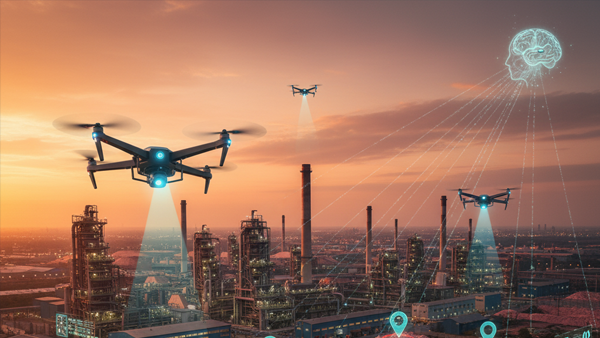
Unauthorized drones represent a growing threat to military installations, critical infrastructure, and public events. Skylark Labs developed counter-UAS software that fuses data from radar, RF sensors, and cameras to detect, classify, and track rogue unmanned aerial systems in real time — strengthening defense and border security operations worldwide.
01The expanding drone threat landscape.
Commercial drones are inexpensive, widely available, and increasingly capable. Military and security organizations face a threat that is difficult to detect with legacy air defense systems designed for larger, faster aircraft. Consumer drones have small radar cross-sections, fly low, and can be modified for surveillance or payload delivery — creating a broad and evolving threat surface that CISA has identified as a critical infrastructure concern.
Single-sensor systems generate high false positive rates, confusing birds and debris with actual UAS threats. Meanwhile, small drones move fast and operate at close range, leaving minimal time between detection and required response. The proliferation of drone incidents near sensitive facilities underscores the urgency of deploying AI-driven solutions that can fuse multiple sensor modalities for reliable detection.
Effective counter-UAS defense requires fusing multiple sensor modalities through AI. No single sensor can reliably detect, classify, and track the full spectrum of drone threats.Dr. Amarjot Singh — CEO of Skylark Labs
02Multi-sensor AI fusion for drone threat detection.
Skylark Labs' counter-UAS software integrates radar tracks, RF signature analysis, and visual confirmation into a single AI-driven decision pipeline powered by the Kepler platform. The system classifies detected objects, assesses threat level, and provides operators with actionable intelligence within seconds of initial detection.
Multi-sensor fusion correlates radar, RF, and electro-optical data to confirm drone presence and reduce false alarms by cross-validating across modalities. The system identifies drone type, manufacturer class, and payload configuration from combined sensor signatures — all processed on edge AI hardware for minimal latency.Highlight — Multi-sensor fusion architecture
Track persistence maintains continuous tracking even when individual sensors lose contact, using predictive trajectory modeling. Each detection is scored by proximity, trajectory, and classification to prioritize operator response — a capability validated through Skylark Labs' counter-UAS demonstrations to DoD stakeholders.
03Operational impact.
Multi-sensor cross-validation eliminates the majority of false positives that plague single-sensor approaches. Automated classification and threat scoring compress the timeline from detection to operator action, while sensor fusion extends effective detection range beyond what any individual sensor achieves alone. The result is a persistent detection layer around protected installations and events — powered by adaptive AI that continuously improves with operational data.
Field deployments have demonstrated that the system maintains detection accuracy across varied environmental conditions, from urban clutter to open terrain. Organizations deploying the Scout AI Tower alongside the counter-UAS software gain integrated airspace and ground-level surveillance from a single command interface.
04Looking ahead.
Skylark Labs' counter-UAS software addresses the fundamental challenge of drone detection: no single sensor is sufficient. By fusing radar, RF, and visual data through AI, the system delivers reliable detection and classification at the speed required to protect military installations, critical infrastructure, and high-profile events from unmanned aerial threats. As the FAA's UAS regulatory framework continues to evolve, automated detection and classification systems will become essential infrastructure for airspace security.