In partnership with ideaForge, Skylark Labs is deploying AI-powered analytics software on defense-grade drones — enabling real-time threat detection and surveillance intelligence across military and border operations. This $35M multi-year partnership positions both companies at the center of the world's largest AI-powered drone ecosystem.
01The Limits of Conventional Drone Surveillance.
Military and border surveillance operations generate massive volumes of aerial imagery that no human team can process in real time. A single long-endurance drone sortie — on platforms like the ideaForge NINJA or SWITCH UAV — can produce terabytes of video and sensor data across electro-optical, infrared, and synthetic aperture radar channels. Analysts reviewing this footage manually introduce hours of latency between the moment an event occurs and the moment it reaches a commander's screen. In fast-moving operational theaters — border incursions, convoy movements, hostile drone activity — that delay can be the difference between interception and escalation.
Conventional drone platforms compound this problem by treating the aircraft as a sensor truck rather than an intelligence asset. Imagery is downlinked to ground stations for post-processing, consuming bandwidth that may not be available in contested or remote environments. When multiple sensor modalities are involved, correlation happens in separate software stacks, further fragmenting the picture. The result is a surveillance architecture that collects more data than it can use, while the threats it was designed to detect move faster than its analysis pipeline.
Drone hardware has advanced rapidly, but the intelligence layer has lagged behind. Our partnership with ideaForge closes that gap by embedding real-time AI analytics directly into the flight platform.Dr. Amarjot Singh, CEO of Skylark Labs
02Embedded AI Analytics for ideaForge Drones.
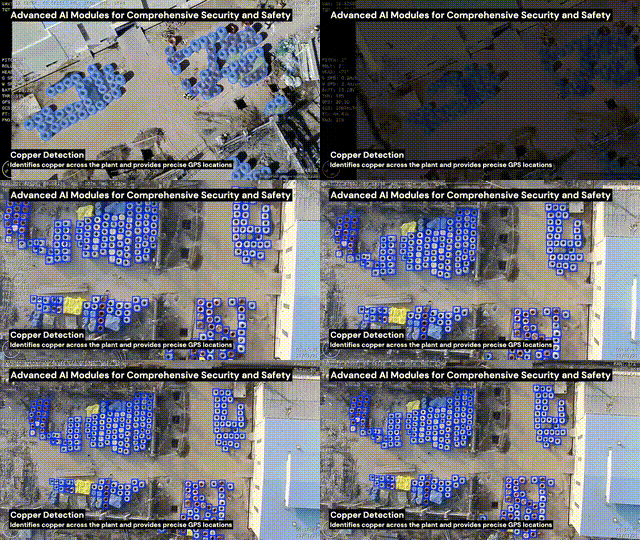
Skylark Labs' software integrates directly into ideaForge's drone hardware, converting the aircraft from a data collector into an autonomous intelligence platform. Rather than streaming raw feeds to a ground station for later review, the system processes sensor data onboard in real time using edge AI hardware. Neural network models — built on Skylark's Kepler platform — identify vehicles, personnel, weapon systems, and infrastructure across varied terrain without operator intervention.
Every detection is automatically geotagged with GPS coordinates and timestamped, so the output is not just an alert but a georeferenced intelligence product ready for integration into command systems.
Multi-sensor fusion is central to the approach. Electro-optical imagery, thermal infrared signatures, and SAR returns are correlated on the edge processor to produce a single, unified situational picture. When one modality is degraded — fog obscuring visible light, heat distortion flattening IR contrast — the system compensates by weighting the remaining channels. This is the same self-evolving AI architecture first announced in the initial partnership.Highlight
03Operational Impact.
The shift from ground-processed footage to onboard intelligence fundamentally changes how drone missions are planned and executed. Commanders receive classified threat data within seconds of detection, enabling tactical responses that were previously impossible within the latency window of traditional ISR workflows. A single AI-equipped drone now covers the surveillance area that previously required multiple aircraft and a team of analysts, reducing sortie counts and operational costs while increasing coverage density. Similar results have been validated in Skylark Labs' counter-UAS demonstrations for the U.S. Department of Defense.
Force protection is another direct outcome. Early identification of hostile activity — whether personnel movement near a perimeter, unregistered vehicles approaching a convoy route, or the thermal signature of an improvised device — allows units to reposition or respond before exposure. Field operators across defense and border programs report that the system's ability to maintain detection accuracy in dust storms, low-light conditions, and extreme temperatures has been a decisive factor in sustained deployments. Skylark Labs' SBIR Phase 2 selection by the U.S. Air Force further validates the company's detection algorithms in degraded visual environments.
04The ideaForge Partnership.
ideaForge builds the most widely deployed defense drones in India, holding nearly 50% market share with platforms operating across the Indian Army, Navy, and paramilitary forces. The company has completed over 850,000 flights and was ranked 3rd globally among dual-use drone manufacturers. Skylark Labs' integration into this fleet means the AI analytics layer ships as a native capability rather than a retrofit. The partnership covers both fixed-wing platforms like the SWITCH UAV and multi-rotor systems like the NINJA, with software updates pushed over the air through the Kepler platform. This is not a pilot program — the system is operational today across active military and security deployments, processing live intelligence on every flight.
05Looking Ahead.
By embedding adaptive AI directly into the flight platform, Skylark Labs and ideaForge have turned every drone mission into an intelligence operation. Raw footage becomes classified, geotagged products before the aircraft lands. This capability is scaling across defense programs — building on the momentum of strategic advisory investments from former AT&T CEO John Donovan — and as the models continue to train on operational data, detection accuracy and threat classification only improve with each deployment cycle.