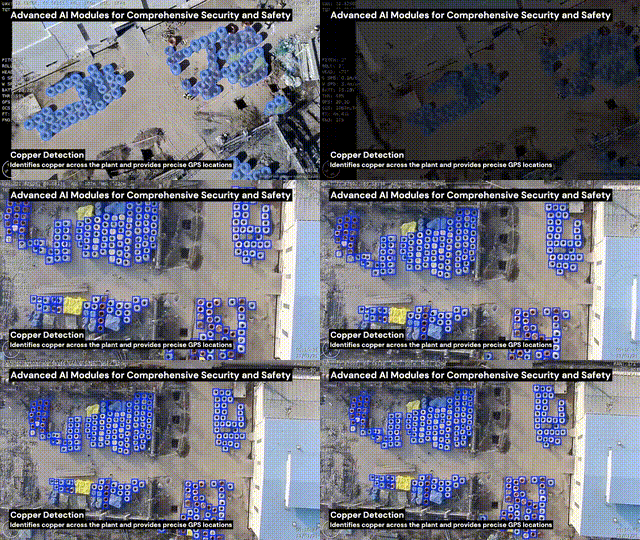
In partnership with CACI International, Skylark Labs delivers enterprise-grade AI surveillance for defense installations, combining multi-camera tracking with automated threat classification to secure critical infrastructure around the clock. The collaboration transforms passive camera networks into active intelligence platforms that think rather than simply record.
01The Security Gap at Defense Installations.
Defense facilities face a persistent tension between the scale of areas they must protect and the personnel available to monitor them. A large military installation may have miles of perimeter fence line, hundreds of buildings, and thousands of camera feeds — far more than any security team can watch simultaneously. Traditional CCTV systems generate enormous volumes of footage, but without intelligent processing, that footage becomes a liability rather than an asset. Operators experience attention fatigue within minutes of continuous monitoring, and critical events are missed or noticed only during post-incident review.
The challenge intensifies with cross-camera tracking. Following a person of interest as they move between non-overlapping camera views requires manual effort, institutional knowledge of the camera layout, and real-time coordination between operators. In practice, this rarely works. By the time an operator identifies a subject on one feed and locates them on another, the trail has gone cold. Meanwhile, the classification problem compounds the tracking problem: distinguishing authorized personnel from potential threats requires contextual awareness — knowledge of access schedules, behavioral norms, and facility zones — that static camera systems simply do not possess.
Defense installations need surveillance systems that think, not just record. Our work with CACI transforms passive camera networks into active security intelligence platforms that detect, classify, and respond in real time.Dr. Amarjot Singh, CEO of Skylark Labs
02Intelligent Surveillance for Critical Infrastructure.
Skylark Labs' AI platform converts existing camera infrastructure into an intelligent security network without requiring hardware replacement. The system, built on the Kepler platform, ingests feeds from existing cameras and applies real-time computer vision models that autonomously track, classify, and alert on security-relevant events. Multi-camera tracking maintains persistent identity as subjects move across cameras, even through gaps in coverage where traditional systems lose the trail entirely.
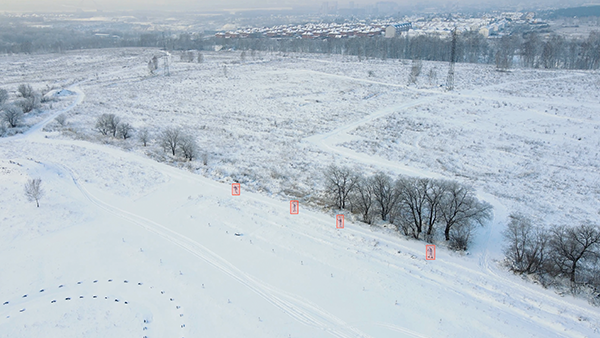
Perimeter intelligence adds another critical layer. The system detects boundary breaches, unauthorized access attempts, and suspicious approach patterns automatically, triggering tiered alerts that route critical events to command staff while sending routine notifications to operators. This prioritization ensures that genuine threats receive immediate attention rather than competing with false alarms for operator bandwidth.
Automated threat classification is where the system delivers its greatest value. Rather than flooding operators with raw alerts for every motion event, the AI distinguishes between authorized personnel, visitors, vehicles, and anomalous behavior patterns. It understands facility zones, access schedules, and normal movement patterns — flagging deviations that human operators would miss in the noise. CACI's ground sensor expertise, combined with Skylark Labs' adaptive AI, creates a layered detection architecture that improves with every deployment cycle.Highlight
03Scaling Security Without Scaling Headcount.
The software-based architecture is a deliberate design choice that enables enterprise-scale deployment. Because Skylark Labs' AI runs on existing camera infrastructure, defense installations avoid the cost and disruption of wholesale hardware replacement. The Sentinel AI Camera and Synapse AI Box can augment existing systems where additional capability is needed, but the core platform works with whatever cameras are already installed — from legacy analog systems to modern IP cameras.
This approach fundamentally changes the economics of facility security. Traditional models scale protection by adding security officers, each representing ongoing payroll, training, and management costs. AI-powered surveillance scales by adding processing capacity — a one-time investment that delivers consistent, fatigue-free monitoring across every camera simultaneously. CACI's defense integration capabilities ensure that the system connects seamlessly into existing command and control architectures, providing intelligence products in the formats and protocols that military operators already use.
04From Passive Recording to Proactive Defense.
The operational impact is measured in response time and detection accuracy. Automated detection reduces the interval between a security event and the first response from minutes to seconds — the AI identifies the threat, classifies its severity, and routes the alert to the appropriate response team before a human operator would have noticed the event on screen. Continuous AI vigilance eliminates the 20-minute attention degradation curve that plagues human monitoring, maintaining consistent detection quality across all shifts, all cameras, and all conditions.
False alarm reduction has been among the most impactful results. By applying contextual intelligence to every detection — is this person supposed to be here? Is this vehicle on the approved access list? Does this movement pattern match known threat behaviors? — the system reduces false alarms by over 90 percent. For security teams that previously spent the majority of their time responding to false triggers, this represents a transformation in operational effectiveness. Personnel are freed to focus on genuine security threats and proactive patrol duties rather than chasing noise. These same capabilities that CACI delivers for electronic warfare and sensor integration are now being applied to the visual intelligence domain through this partnership.
05The Future of Enterprise Defense Surveillance.
The CACI partnership validates Skylark Labs' approach to enterprise defense surveillance at scale. By layering adaptive AI onto existing camera infrastructure, defense installations gain persistent, intelligent monitoring without the cost and disruption of wholesale system replacement. As the Department of Defense accelerates its AI strategy, the ability to transform legacy surveillance into intelligent security networks becomes a force multiplier that scales with the facility rather than with headcount. The system continues to improve with every deployment cycle — learning new patterns, refining classifications, and adapting to evolving threats — making each installation smarter than the last.