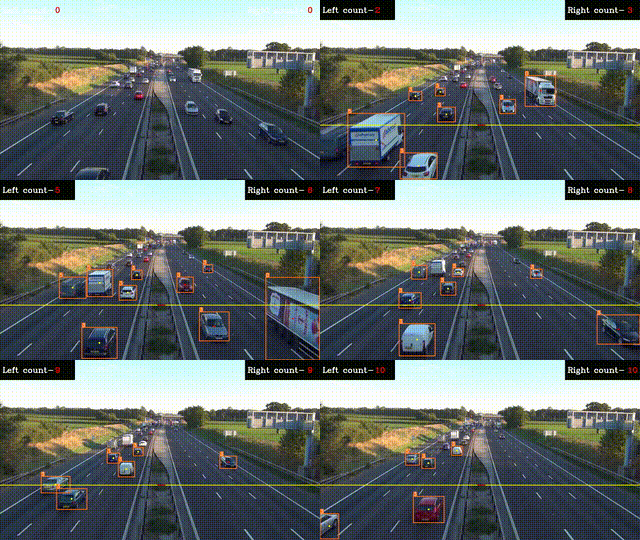
Accurate vehicle counts are foundational to traffic engineering, yet traditional counting methods remain labor-intensive and error-prone. Skylark Labs developed an AI-powered vehicle counting system for EDRC that delivers continuous, automated traffic data from standard roadside cameras through the Kepler platform.
01Why Traditional Traffic Counting Falls Short.
Manual traffic surveys require personnel stationed at intersections for hours, producing data for limited time windows. Pneumatic tube counters and inductive loops are expensive to install, prone to damage, and cannot distinguish between vehicle types. Manual counts capture only a few hours per day, missing overnight traffic and weekend patterns entirely.
Tube counters and loops detect axles, not vehicle types, making it impossible to distinguish cars from trucks. Staffing manual counts at multiple intersections simultaneously requires significant personnel budgets. Physical counting equipment degrades in harsh conditions, creating gaps in long-term traffic datasets that undermine planning accuracy. Modern intersection data solutions demand continuous, classified counts that legacy methods cannot provide.
When traffic data becomes continuous rather than sampled, transportation planning shifts from estimation to evidence-based decision-making.Dr. Amarjot Singh, CEO of Skylark Labs
02Vision-Based Automated Traffic Intelligence.
Skylark Labs' system processes live video from standard traffic cameras using computer vision models that detect, classify, and count vehicles in real time. The platform outputs continuous traffic flow data, vehicle type breakdowns, and congestion metrics without additional roadside hardware -- all running on the Synapse AI Box at each monitoring point.
The Kepler analytics platform transforms raw counting data into actionable dashboards that transportation planners can use for signal optimization, capacity planning, and infrastructure investment decisions -- all derived from cameras already deployed at key intersections.
Multi-class vehicle counting distinguishes and counts cars, trucks, buses, motorcycles, and auto-rickshaws in mixed-traffic environments. Traffic density estimation calculates real-time occupancy and density metrics per lane, enabling congestion detection before it propagates. Peak hour analytics identifies peak traffic periods automatically from continuous data, supporting signal timing optimization. Directional flow tracking produces origin-destination matrices for intelligent transportation planning through comprehensive road analytics.Highlight
03Better Data, Better Infrastructure Decisions.
Automated counting replaces periodic manual surveys with 24/7 data collection, capturing complete traffic patterns including overnight and weekend flows. Computer vision models maintain consistent accuracy across lighting conditions and traffic densities, eliminating the variability inherent in human counting.
The system eliminates recurring labor costs for manual counts and maintenance costs for physical counting equipment. Rich vehicle classification data supports more informed decisions about road widening, signal placement, and transit routes across the strategic infrastructure network -- giving planners the granular, always-on data they need.
04Transforming Traffic Data Collection.
Skylark Labs' vehicle counting system for EDRC demonstrates that standard traffic cameras can be transformed into continuous data collection instruments. By replacing manual surveys with automated, multi-class vehicle counting, the system provides transportation planners with the granular, always-on data they need to make informed infrastructure decisions.