AI is deployed everywhere -- from smartphones to industrial control systems. But most AI models stop learning the moment they leave the lab. Edge adaptability is the ability of an AI system to learn and adjust on-device, in real time, without retraining or cloud connectivity.
01Why Adaptability Matters.
The real world changes constantly. Adversaries shift tactics, road conditions deteriorate, new threats emerge. Static AI systems cannot keep pace. This "adaptability gap" is the central obstacle to deploying AI in mission-critical environments where failure is not an option.
In defense, adversaries evolve tactics continuously, demanding AI that adapts to new threats in real time. In transportation, autonomous systems must handle unpredictable road conditions and novel scenarios on the fly. In public safety, threats evolve rapidly, requiring AI that learns and responds to new patterns instantly. And on industrial campuses, dynamic environments with changing equipment, personnel, and hazards need AI that adapts continuously.
The need for AI systems that can learn, reason, and adapt like humans has never been more urgent.-- Skylark Labs
02How Traditional AI Learns.
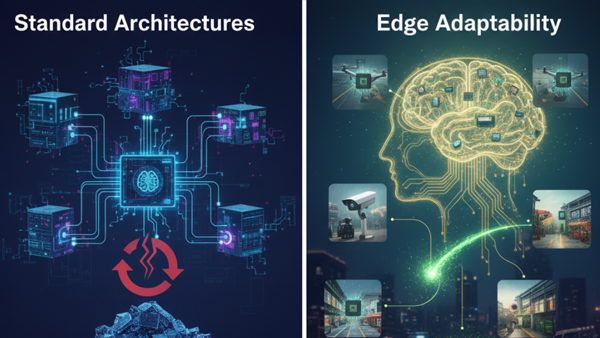
Standard architectures like Transformers, CNNs, and GNNs process large datasets to identify patterns. They work well for specific tasks but remain static after deployment, requiring expensive retraining to handle new scenarios.
The learning hierarchy starts with low-level features -- edges, textures, and basic elements -- then builds to mid-level features like shapes and structures, and finally reaches high-level abstractions such as objects and actionable insights. These layers combine into task-specific models that generalize well but cannot evolve post-deployment.
03What Edge Adaptability Enables.
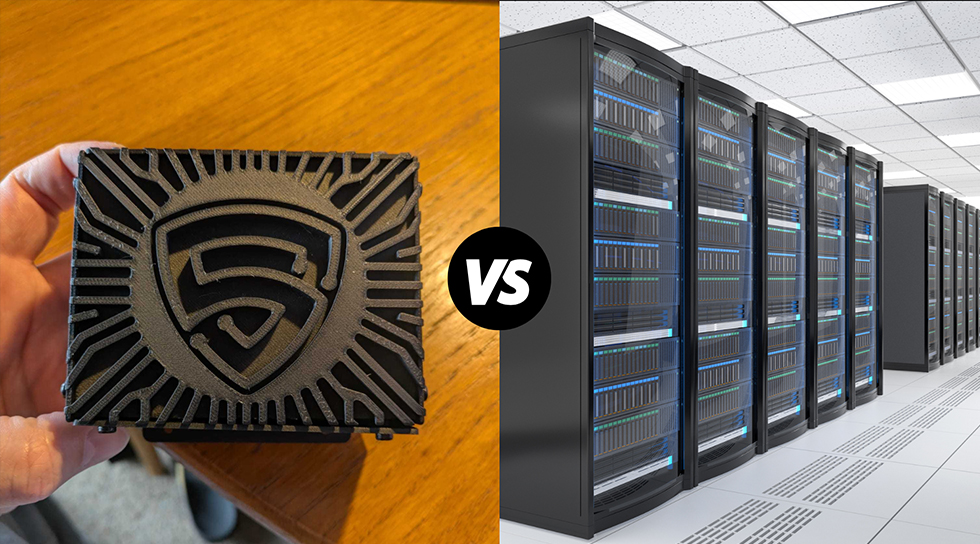
On-device learning in real time, without datasets or retraining, unlocks capabilities that static AI cannot match. The Synapse AI Box from Skylark Labs exemplifies this approach -- processing data at the edge with adaptive intelligence.
These capabilities mean AI systems can operate effectively in unpredictable environments, learning as conditions change -- a requirement across defense, public safety, and transportation applications.
Self-Identification: Detects new events and anomalies -- including false positives -- without prior training data. Real-Time Adaptation: Responds to new signals without cloud retraining or historical datasets. Single-Shot Learning: Achieves understanding from a single image or experience, enabling immediate adaptation.Highlight
04The Path Forward.
Once deployed, conventional AI cannot adapt without costly retraining cycles. Edge adaptability eliminates this constraint entirely. As MIT Technology Review noted, "The way we train AI is fundamentally flawed." Systems that learn on-device, from single experiences, represent the next generation of AI -- one that adapts like humans do.
Skylark Labs' CFAMs architecture powers this adaptive capability, processing sensor data through the Kepler platform and enabling real-world adaptation across mission-critical environments.